Pizza Dough Troubleshooting: Diagnose Before You Fix
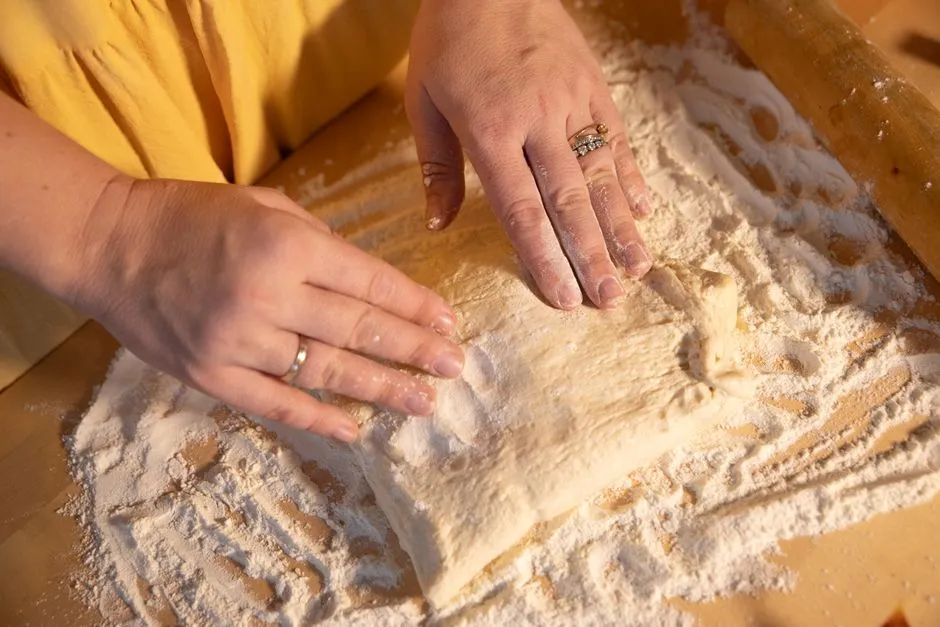
- Where should pizza dough troubleshooting start?
- Which stage first went wrong?
- What should you check during mixing?
- What does adding flour actually change?
- Why is the dough not rising?
- Why does it snap back when stretched?
- What if dough tears instead of shrinking?
- Why did the surface form a dry skin?
- Is it a dough problem or a topping problem?
- How can you record a useful next batch?
- Which safety checks override troubleshooting?
- Sources
Where should pizza dough troubleshooting start?
Start pizza dough troubleshooting with when the problem appeared: mixing, rising, shaping or topping. Check recorded weights, temperatures and handling before changing the recipe. Tight dough and collapsing dough need different responses; stickiness alone does not identify the cause. Never taste raw dough or use its smell to establish safety. Discard dough with uncertain storage history, and follow the recipe's food-handling controls and your oven's manual.
This guide covers wheat-based, yeast-leavened pizza dough before and after shaping. It is a diagnostic framework, not a new fermentation schedule or a claim that we tested every rescue. Gluten-free dough needs its own recipe and handling method.
Keep two decisions separate: whether a batch has been handled safely, and whether it has the structure needed for your intended pizza. A dough can fail either check. Better stretching does not resolve a food-safety problem.
Which stage first went wrong?
Write the first observed change, not just the final disappointment. “Sticky after mixing” and “smooth after mixing, sticky after a long proof” are different records.
The flour producer Ardent Mills' pizza troubleshooting guide starts with questions about weighed ingredients, written methods and dough temperature. Its chart gives multiple possible causes for the same result. Use that approach to narrow the next check.
| Observation | Check first | Avoid assuming |
|---|---|---|
| Dry pockets remain during mixing | Recorded water and flour; incomplete incorporation | Every rough dough needs more water |
| Dough sticks immediately | Recipe consistency, flour choice and measured quantities | Sticky automatically means overproofed |
| Dough barely expands | Yeast handling, actual temperature and recipe stage | Another hour will always solve it |
| Dough shrinks while opening | Recent shaping and resistance to stretching | More pulling will make it relax |
| Dough rose, then became fragile | Proof history and whether it has lost structure | It needs still more proofing |
| Only the exposed surface is tough | Cover and drying | The whole formula lacks water |
| Base sticks after topping | Thin spots, moisture and peel condition | Fermentation must be wrong |
The table is a set of questions, not a diagnosis from a photograph. Compare the suspect batch with the same recipe's intended appearance at the same stage.
What should you check during mixing?
First compare the actual ingredient record with the recipe. Did the bowl get zeroed on the scale? Was a half batch calculated for every ingredient? Was the flour changed? Is there an ingredient still measured in cups while the rest is weighed?
King Arthur Baking's New York-style pizza workbook, page 9, separates stiff dough from sticky dough. It recommends accurate scale measurements, rest for stiffness, and light flouring of hands and the work surface for stickiness. Its explanation includes flour hydration and gluten relaxation. That is not a direction to knead handfuls of flour into every soft dough.
Complete your chosen recipe's mixing and covered rests before declaring its expected texture a defect. Do not replace its whole process with a longer mixer run. If the machine is involved, stay within its dough capacity and operating instructions.
A useful note is “rough, with dry flour visible on the bowl” rather than “bad gluten.” The first describes evidence you can check; the second jumps to a cause.
What does adding flour actually change?
Hydration means water weight divided by flour weight, multiplied by 100. King Arthur's baker's-percentage reference uses flour as the 100% reference, not total dough weight.
Here is an original arithmetic example, not a recipe or a tested rescue:
| Recorded ingredient | Before extra flour | After 25 g is fully incorporated |
|---|---|---|
| Flour | 500 g | 525 g |
| Water | 325 g | 325 g |
| Salt | 10 g | 10 g |
| Instant yeast | 1 g | 1 g |
| Total | 836 g | 861 g |
| Hydration | 65% | About 61.90% |
| Salt percentage | 2% | About 1.90% |
| Yeast percentage | 0.20% | About 0.19% |
The new hydration is 325 ÷ 525 × 100, not 65% minus 25. Adding flour changes the reference weight for salt and yeast too. A dusting left on the counter is not automatically part of the dough; the example assumes all 25 g entered it.
This is why a rescue needs a written amount. If next week's dough starts with the original quantities but you compare it with last week's flour-adjusted batch, you are comparing different formulas. For related formula reading, browse the dough collection.
Why is the dough not rising?
Before changing yeast, check its type, amount, storage directions and package date. Check the liquid temperature actually used and the dough's environment, rather than describing both as “warm.”
Red Star's troubleshooting guide lists insufficient or inactive yeast, excessively hot liquid, cold ingredients and too much salt among reasons for slow or absent rise. These are alternatives to investigate, not instructions to change all four inputs.
Use the yeast maker's directions if you need to check an unused package's activity. Do not add an unmeasured second dose to an already mixed batch and assume the original schedule still applies. Our editorial recommendation is to restart from a documented formula when a major omission cannot be reconstructed reliably.
A cold-fermented recipe deliberately uses a different environment from a quick room-temperature dough. Its clock is not interchangeable with another recipe's. Do not accelerate a stalled batch beside a live oven, over a heater or inside an unmeasured heated appliance.
Why does it snap back when stretched?
Shrink-back describes resistance: the dough extends under pressure, then contracts. In King Arthur's pizza-shaping explanation, kneading, folding and shaping can leave gluten resistant to stretching. The baker's suggested first response is a 15-minute rest, covered so the surface does not dry.
Use that as a reassessment point within your recipe's handling limits, not a guaranteed finish or a new unlimited counter hold. Return to gentle pressing instead of pulling harder. Record whether resistance actually decreased.
If the ball was just reshaped, write that down. It is easy to mistake a shaping effect for a flour problem and change the whole formula unnecessarily.
What if dough tears instead of shrinking?
Look at where the break begins. A thin central patch that tears during opening suggests a different handling question from a ball that cannot be removed intact from its container.
King Arthur's workbook advises slower stretching and keeping tear-prone dough on the bench longer. Check the original ball weight and intended diameter before insisting that every portion reach the same large size.
Dough that has risen too long can become fragile and collapse when touched, as King Arthur's proofing guide explains. More waiting is not the same response as the covered rest for resistant dough.
There is no universal reball-and-wait cure here. A handling change cannot establish safety or guarantee that a weakened batch will support toppings. If you cannot shape it reliably, stop that pizza attempt. Do not improvise a thicker, folded or pan-baked rescue without a complete appropriate baking method.
Why did the surface form a dry skin?
Check whether the cover was displaced or the ball sat exposed while others were being prepared. Red Star specifically recommends covering rising dough to prevent a crust from forming.
Keep the remaining portions covered in suitable food containers according to the recipe. Do not confuse an ordinary dried surface with suspicious discoloration or mold; uncertain or spoiled food belongs in the discard decision, not the shaping experiment.
For the next batch, record the container and cover alongside the ingredients. “Same flour, different uncovered tray” is a meaningful difference.
Is it a dough problem or a topping problem?
If the bare base moved freely but the topped pizza stuck, inspect the assembly stage. Ooni's launch guidance identifies sauce reaching the peel through holes, a hot preparation peel, heavy toppings and a long wait after topping as sticking contributors.
Check for holes before adding sauce, keep the preparation surface appropriate to the method, and assemble only when ready. Do not force a stuck pizza toward a hot oven.
After baking, record underside, rim and centre separately. Ardent Mills lists wet toppings, insufficient baking and oven conditions among explanations for a soft or doughy crust. A browned edge alone does not settle the centre's doneness. Follow the complete recipe's baking instructions; do not taste undercooked dough as a diagnostic.
How can you record a useful next batch?
Use this compact worksheet:
- Formula: source, batch size, flour product and actual ingredient weights.
- Conditions: measured dough, room and refrigerator temperatures where relevant.
- Sequence: mix, rest, divide, refrigerate, remove and shape times.
- First symptom: stage, location and what changed.
- Decision: continue within the recipe, stop, or discard for safety.
- Next comparison: one named change; all other recorded inputs held steady.
For a fictional example, Batch A was smooth after mixing but repeatedly shrank immediately after reballing. Batch B's proposed comparison keeps the recipe and ingredient quantities unchanged and records a covered shaping rest before reassessment. No outcome is claimed.
By contrast, changing flour, yeast and water together would leave three competing explanations. One comparison may suggest a useful next step; it does not prove a universal rule.
Which safety checks override troubleshooting?
The FDA's flour guidance says not to eat or taste raw flour or dough. Keep raw flour away from ready-to-eat food. Wash hands with soap and running water and clean utensils and surfaces with warm soapy water after handling it. Follow package cooking directions where supplied; home heat treatment does not make flour suitable for raw eating.
FDA storage guidance specifies refrigeration at or below 40°F (4°C). Perishable toppings and leftovers should not sit out more than two hours, or one hour above 90°F. Discard improperly stored or suspicious food; normal appearance and smell do not prove safety. These limits are not a replacement fermentation schedule.
For outdoor cooking, USFA advises supervision and separation from combustibles, and recommends long-handled utensils and grill mitts to prevent burns. Follow your pizza oven's own location, clearance, fuel and tool requirements. Keep children and pets away. Equipment faults go to the manufacturer or a qualified technician.
The oven and fire collection covers that separate topic. Fix dough decisions at the preparation bench; do not improvise equipment changes to compensate for them.
Sources
- Ardent Mills: Pizza Troubleshooting Guide
- King Arthur Baking School: New York-style pizza workbook
- King Arthur Baking: Baker's Percentage
- Red Star Yeast: Tips and Troubleshooting
- King Arthur Baking: Pizza dough shrink-back
- King Arthur Baking: Recognizing proofed dough
- Ooni: Launch preparation
- FDA: Handling Flour Safely
- FDA: Are You Storing Food Safely?
- USFA: Outdoor Fire Safety
- USFA: Outdoor fire-safety pictographs